




Naqshabandi founded his Order based on these eight Order rules, having added another three additional rules. He was a supporter of simplicity treating negatively religiosity, loud zikr and forty-day fasting. The main principle of his teaching was "Dil ba eru dast ba kor" - "Heart with Allah, hands in work".
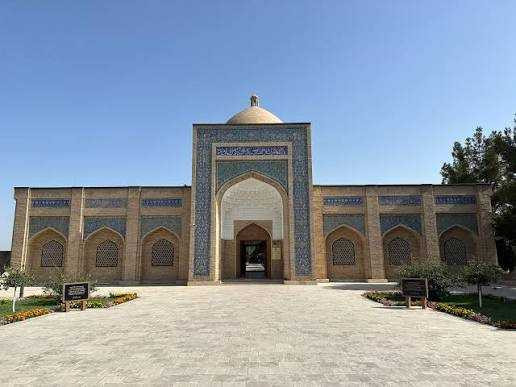
A researcher from Uzbekistan writes about Hazrat Naqshband (RA)
Naqshabandi founded his Order based on these eight Order rules, having added another three additional rules. He was a supporter of simplicity treating negatively religiosity, loud zikr and forty-day fasting. The main principle of his teaching was "Dil ba eru dast ba kor" - "Heart with Allah, hands in work". According to his teaching, the comprehension of Allah takes place though the soul while the hand should always be busy with work. The Order symbol was a heart with the word Allah inside it.
Uzbekistan widely celebrated the 675 anniversary of Bahouddin Naqshbandi in 1993. His tomb with the complex adjacent to it became a place of pilgrimage in Uzbekistan. The Academy of Sciences of Uzbekistan keeps 195 scientific papers and books about Bahouddin Naqshbandi.
So fawqa kulli dhi 'ilmin' aleem - above every knower there is a higher knower.
So it is a waste of time, not a waste, but above every knower there is a higher knowledge. Knowledge never ends.
In his time, as Grandshaykh may Allah bless his soul, "Every night he used to feed 5000 people and they were studying in his school," and til today you can go and see his school.
He said that "one time there was drought in the city, in Samarqand and there is no more wheat for people to eat. There is no rain, there is no more food.
They came to Sayyidina Shah Naqshband and said, "Ya Sayyidee this is situation and people are dying from hunger there is no rain." What did he do? He said, "Is there any house that has any grain?" They looked and looked and looked and found one house of one rich person, who is the richest person in area, he has a little bit of grains of wheat of flour. They brought it to Sayyidina Shah Naqshband and said, "this is what we found." He said, "take it to windmill and I am coming." So they went to the mill and you know they used to grind wheat in those days with two buffalos.
The buffalo puts its head between the yoke and then he turns the wheel and it grinds the flour. At that time they choke on the stones that come in the bread.
"So Shah Naqshband said, "bring that grain" and they took the grain of wheat and Sayyidina Shah Naqshband he put the grain on the millstone that is going to turn and they put, usually they put two buffaloes or two donkeys. So there were two buffalos or two donkeys and they tie one to one side of the stone and tie to the other side of the stone and then Shah Naqshband took one of the ropes away and with the other buffalo he began to turn the windmill. As he is turning wheat is coming from all directions. He ordered all the villages that are outside that village to come, as much as they can to take of flour. And from morning to evening except the prayers that wheat is coming out until the whole area Bukhara, Samarqand and Merv, was covered with wheat it might be enough for 10 years. Everyone was a student of his knew what he was doing.
So everyone went back and they were happy.
So Sayyidina Shah Bahauddin Naqshband when he was dying many years later with all he was doing of khayr to feed people to guide them to teach them. He was biggest guide of people, and the angel of death was coming to take his soul.
So angel of death came to Sayyidina Shah Naqshband. He is protected Sayyidina Shah Naqshband. As soon as the angel of death came for Sayyidina Shah Naqshband to meet his lord, as soon as they begin to see him, when he is on the bed, flipping on the ground. How you say? Flipping, falling and falling on his face. Rubbing his beard on the ground and saying: "Ya 'Afuw, Ya Afuw..." Rubbing his lahyatush-shareefa 'ala al-ard. Seven times saying, "Ya 'Afuw." Then they put him on the bed. Then he falls down. Then he says: "Ya 'Afuw, Ya' Afuw..." seven times. Then they put him on bed and then he falls saying, "Ya Afuw, Ya' Afuw....." Each time they put him he falls. You know Ya 'Afuw means The One Who Forgives. Everyone was surprised at Sayyidina Shah Naqshband, though of course everyone has to say "Ya 'Afuw."
Any student that is doubtful will say, "O look at what kind of death," as they cannot understand any hikmat out of it except his student and successor, Ala'uddin al-Attar. He understood why. for Shah Naqshband whispered to him.
When he saved thousands and hundreds when he put himself in place of the buffalo to make that flour to come out, then why is he saying "Ya 'Afuw"? Allah was saying to him: "O Shah Naqshband. Why are you interfering in My Will. It is not up to you to feed them - it is up to Me."
He said, "Ya 'Afuw" because without permission from the Prophet (s), as always when he wants to make a miracle he must get authorization from the Prophet (s) to make a miracle. If not, then he falls into the category of sin. So that is why Naqshbandi shaykhs don't like to make miracles. They don't want anyone to know about them, they are hidden.
Today those who are representatives of shaykhs around the world they show they know everything. Look Sayyidina Shah Naqshband, was rubbing his head his beard on floor and saying, "I was not right to do that. It is as if I canceled Your Will."
Only when we get permission from the Prophet (s), then is it is according to the Will of Allah.
So even låst moment in his life he is asking forgiveness.
So where is understanding of a guide today? The meaning of a guide is not simple, it is not easy. It is not something you go to university and buy it and study for it, it is a grant from Allah. If Allah gives it.
We go back, when Sayyidina Abu Bakr as-Siddiq heard that hadith said, "stop! I don't want to be problem to myself." What did the Prophet (s) say? Allahuma la takilnee ila nafsee tarfata 'aynin wa la' aqal min dhalik - don't leave me to my ego for blinl: of an eye or less." Does the Prophet (s) have ego? No! But even sc he is saying "Don't leave me to my ego for blink of an eye."
So like children how much you have go, they say I have this much [stretch arms].
So how much ego do you have?
So don't say I know something. The Prophet (s) who passed through the horizon that is no end, horizon that is qaaba qawsayni aw adna, still he said, "don't leave me to my ego for the blink of any eye."
So what did Abu Bakr as-Siddiq do? He took a stone and put it in his mouth, for seven years and did not take it out unless necessary.

![Data Ganj Bakhsh [ Hazrat Ali Hujwiri (RA) ]](https://www.sufi.news/upload/media/posts/2026-09/10/data-ganj-bakhsh-hazrat-ali-hujwiri-ra_1789055296-s.jpg)



Comments
0 comment